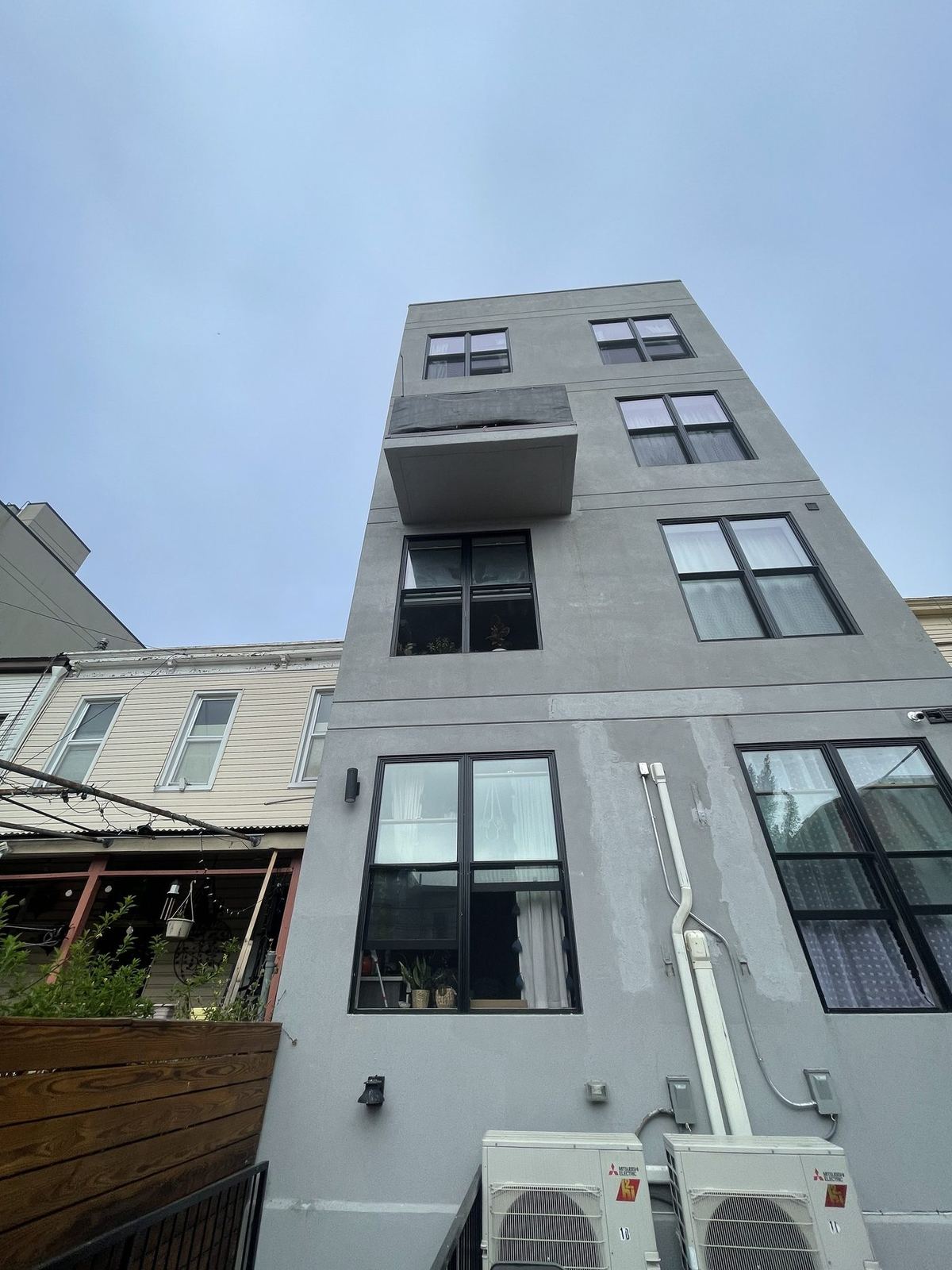
Stand across the street from any commercial building in New York and you are looking at two things at once: a face, and a roof turned sideways. A facade's job is to shed water, resist wind and sun, and protect everything inside the wall — while also being the building's entire public presentation. Facade and stucco restoration is where those two jobs meet, and as a general contractor in NYC performing commercial renovation in New York, we can tell you the work succeeds or fails at the details most people never look at: the edges.
Start with the diagnosis, not the scaffold
Exterior restoration begins with reading the building. Staining patterns, cracked or drummy stucco, spalling at edges, rust marks at lintels, open joints — each is a symptom pointing at where water is getting in and where it travels once inside. Water rarely enters where the damage shows; it enters at a failed detail above and migrates. Restoring the surface without finding the entry point produces a beautiful repair that fails on the same schedule as the original.
Access shapes the diagnosis too. Scaffold, lifts, or rigging determine how much of the facade can be inspected closely, and a proper condition survey during planning prevents the most common exterior-project surprise: discovering, mid-job and at height, that the damage runs deeper than the elevation suggested.
Stucco restoration: a system, not a smear
Stucco is a layered system, and restoring it properly means respecting the layers. Failed or delaminated areas are cut back to sound material, the substrate is prepared, and base coats rebuild the plane before the finish coat restores texture and appearance. Color and texture matching on an existing building is its own craft — a patch that performs perfectly but reads as a patch from the sidewalk is half a job.
Large flat fields of stucco also depend on what happens at their boundaries: control joints that let the material move, clean terminations at windows and trim, and transitions to other materials detailed so water is directed out and over, never in and behind. The finish coat is the visible ten percent of the system; the ninety percent beneath it decides how long the ten percent lasts.
Parapets and coping: the top edge decides everything
If one detail governs a facade's life, it is the parapet — the low wall at the roof's edge — and its coping, the cap that covers it. The parapet takes weather from both sides and from above, and its coping is quite literally the building's first line of defense. Cracked coping joints, displaced stones or metal caps, and failed flashing at the parapet's base let water into the wall assembly at its most vulnerable point, where it can damage the facade below, the roof edge, and the top-floor interiors in one quiet motion.
Restoration at the parapet means rebuilding what has failed — repointing or rebuilding masonry, resetting or replacing coping, renewing the flashing and counter-flashing where parapet meets roof — and, just as importantly, giving the top of the wall a finished profile that sheds water outward instead of ponding it in joints. Owners often meet this scope for the first time during roof or facade work; the honest advice is that the parapet is never the place to defer.
Bulkheads and the roof-level structures
Bulkheads — the small structures housing stair and mechanical access at the roof — live the hardest exterior life on the building: full sun, standing weather, and four exposed walls plus a cap. Their stucco and masonry crack at corners, their doors and frames corrode, and their flashing takes the runoff of everything around them. Restoring a bulkhead with the same system care as the main facade — sound substrate, proper coats, sealed transitions, renewed cap and flashing details — closes one of the most common and least glamorous sources of top-floor leaks.
Water protection is a whole-facade discipline
Beyond any single element, restoration is about restoring the facade's logic of shedding water: sound joints, sealed penetrations, drip edges that throw water clear of the wall, sills and lintels that slope outward, and transitions — roof to wall, addition to original, stucco to masonry — detailed so each material hands water to the next without a gap in the story. Coatings and sealants have their place in that system, as components with a service life, not as substitutes for failed construction underneath them.
Access, protection, and the public way are part of the work as well: sidewalk protection, scaffold coordination, and keeping entrances and neighbors' property safe and clean are obligations an NYC exterior contractor plans from the first day.
What drives the scope and the budget
Facade budgets follow access, area, and what the diagnosis finds: how much material is failed versus sound, the height and rigging required, the parapet and coping condition, and how much substrate repair hides behind the surface. That is why the walkthrough — or in this case, the close-up survey — matters more on exterior work than almost any other scope.
Have a building whose exterior needs attention?
Art-Tech Construction Corp provides facade and stucco restoration and commercial exterior renovation across Manhattan, Brooklyn, Queens, the Bronx, and Staten Island, and has since 2017. Start with a survey and an honest scope. Call (212) 960-3895 for a free consultation and a free quote.
Planning a project like the ones described here? Start with a free consultation and a free, detailed quote — call (212) 960-3895 or use the contact form.